
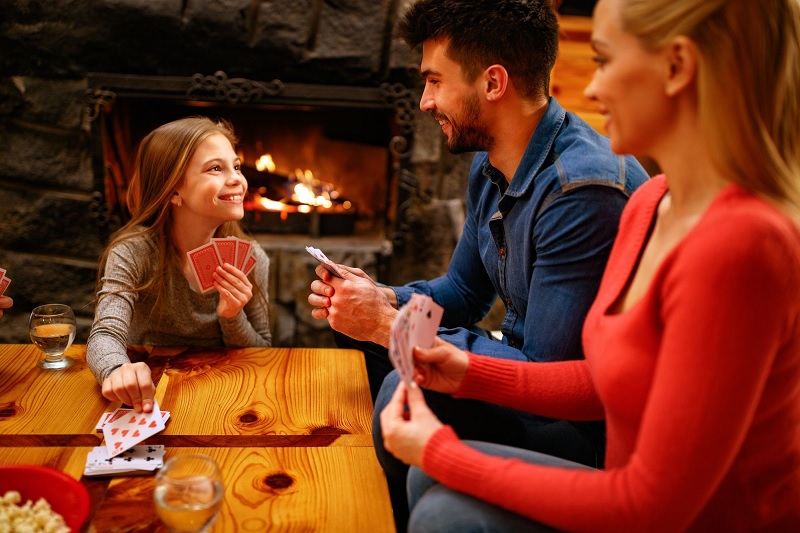
A standard deck of fifty-two playing cards is arguably the most efficient entertainment system ever invented. Unboxing a fresh deck offers immediate access to centuries of mathematical strategy, psychological warfare, and cooperative gameplay. While modern families frequently turn to expensive board games or digital consoles for evening entertainment, a simple deck of cards provides an unmatched level of versatility. The true magic of card games lies in their variations. Once your family understands the foundational mechanics of matching, shedding, or trick-taking, you can introduce countless regional and strategic variations that completely change the dynamic of the living room table.
Moving beyond the basic childhood staples like Go Fish or simple War introduces children, teenagers, and adults to complex problem-solving and strategic planning. Exploring the deeper, more nuanced variations of classic card games can transform a quiet evening into a highly engaging, fiercely competitive, and memorable family event.
The Rummy Architecture: From Classic to Contract
Rummy is not a single game, but rather a massive family of games based on the core mechanic of drawing, discarding, and melding cards into sets and runs. While basic Rummy is a great starting point, introducing advanced variations forces players to adapt their strategies and plan multiple turns ahead.
Contract Rummy
Also known as Liverpool Rummy or Phase 10 in its commercialized boxed version, Contract Rummy is a phenomenal variation for larger families. The game is played over a series of sequential rounds, and in each round, players must achieve a specific “contract” before they are allowed to lay down their cards.
For example, the first round might require players to collect two distinct sets of three cards. The second round might demand one set of three and one sequential run of four in the same suit. The contracts become progressively more difficult as the game advances, requiring larger hands and more complex combinations. This variation is particularly brilliant for families because it naturally handicaps the game. A player who receives incredibly lucky draws in the first round will still have to grind their way through the complex requirements of round six. It requires long-term hand management, as discarding the wrong card early in a round can completely sabotage your required contract.
Gin Rummy
When the family game night splits into smaller groups, Gin Rummy is the absolute pinnacle of two-player card strategy. Unlike traditional Rummy, players do not lay their melds face-up on the table during the game. Instead, you hold your entire hand privately, attempting to construct a fully connected hand of sets and runs. The round only ends when a player “knocks” by revealing a hand with very few unmatched cards, or “goes Gin” by seamlessly matching every single card they hold. It is an excellent game for a parent and older child, teaching deduction, memory, and the calculated risk of holding onto a high-value card in hopes of completing a run.
Trick-Taking Tactics: Precision and Partnerships
Trick-taking games represent some of the most intellectually stimulating card games in existence. In these variations, all players play a single card to the center of the table, and the highest card of the leading suit wins the “trick.”
Oh Hell
While Spades and Hearts are the most famous members of the trick-taking family, Oh Hell is widely considered the most balanced and educational variation you can play with a family. Before the cards are played, every player looks at their hand and must bid on exactly how many tricks they believe they will win.
The catch is that the total number of bids cannot equal the total number of tricks available, ensuring that at least one person at the table will fail to meet their bid. To win at Oh Hell, you cannot just rely on having the highest cards. If you bid three tricks, you must win exactly three. Winning four is just as penalizing as winning two. This variation teaches exact probability, risk management, and the art of intentionally losing a hand to preserve your precise bid. It levels the playing field entirely; a player with a terrible hand can easily outscore a player with a great hand simply by bidding zero and strategically dodging every trick.
Spades
If your family prefers teamwork, Spades is the ultimate partnership variation. Played with four people split into two teams, Spades introduces the concept of a permanent trump suit. No matter what suit is led, a Spade will always win the trick. The communication dynamics in Spades are fascinating, as partners must bid on their combined total of tricks without explicitly telling each other what cards they hold. It requires intuition, trusting your partner to cover your weaknesses, and carefully tracking which high Spades have already been played.
The Shedding Games: Hierarchy and Chaos
Shedding games are entirely focused on being the first person to empty your hand. While Crazy Eights is the baseline version most children learn, the shedding variations enjoyed by teenagers and adults introduce fascinating social mechanics and shifting power dynamics.
President
Often known by various regional names like Scum or Capitalism, President is a brilliant variation that introduces social hierarchy into the gameplay. The objective is to shed your cards by playing higher values than the person before you. If someone plays a pair of fives, you must play a higher pair.
The genius of President lies in the aftermath of the first round. The first person to empty their hand earns the title of President, while the last person is deemed the Scum. In the following round, the Scum must physically deal the cards, clear the table, and pass their two highest-value cards to the President. In exchange, the President gives the Scum their two worst cards. This creates a fiercely competitive environment where players are constantly fighting to dethrone the leader or claw their way out of the bottom rank. It is highly engaging, loud, and perfect for families with competitive teenagers.
Memory and Mitigation: The Golf Variations
Not all card games require intense mathematical calculation or aggressive take-that mechanics. The Golf family of card games is highly strategic but operates at a much more relaxed, conversational pace.
Six-Card Golf
In Six-Card Golf, the objective is to finish the game with the lowest possible score, much like the physical sport. Each player is dealt a grid of six cards face-down. You are only allowed to look at two of your cards. On your turn, you draw a card from the deck or the discard pile and swap it with one of the face-down cards in your grid, attempting to lower your overall numerical total.
The strategic twist is that any two matching cards in the same column cancel each other out, scoring zero points. Therefore, if you have a high-value King in your grid, you can either try to replace it with a low card like a two, or you can take a massive risk and try to blindly find another King to place above it and zero out the column. It requires sharp memory, spatial awareness, and a high tolerance for risk, making it an incredibly addictive variation for players of all ages.
High-Velocity Physical Games: Spoons and Nerts
Sometimes, a family game night needs an injection of pure adrenaline. Physical card games blur the line between a tabletop game and a competitive sport, requiring rapid hand-eye coordination and split-second processing speeds.
Spoons
Spoons is a drafting game combined with musical chairs. You place a number of metal spoons in the center of the table, exactly one fewer than the number of players. The dealer rapidly draws cards and passes them to their left, and every player simultaneously passes unwanted cards to the next person, trying to build a four-of-a-kind. The moment a player achieves four matching cards, they grab a spoon from the center. This triggers a frantic free-for-all as everyone else immediately dives for the remaining spoons, regardless of what cards they hold. The player left empty-handed receives a letter, spelling out S-P-O-O-N until they are eliminated. It is chaotic, hilarious, and requires zero waiting for turns.
Nerts
For a slightly more sophisticated but equally rapid variation, Nerts is essentially multi-player, real-time Solitaire. Every player requires their own deck of cards with a distinct backing. You set up a traditional Solitaire tableau in front of you, but the Ace foundations are played in the center of the table and are shared by everyone. There are no turns; everyone is rapidly flipping through their decks and slapping their cards onto the communal Aces in real time. It is a true test of processing speed and peripheral vision.
Exploring these variations breathes permanent life into a standard deck of cards. By shifting the mechanics from simple matching to complex bidding, physical drafting, or shifting hierarchies, you ensure that family game night never grows stale. A single deck contains thousands of hours of varied entertainment, provided you are willing to learn the rules and shuffle the cards.